
Duct cleaning and indoor air quality in Fairfax, VA are connected, but the case for cleaning is more specific than most ads suggest. The EPA does not recommend cleaning ducts on a schedule. It identifies three specific conditions that make cleaning necessary. Knowing those conditions, and the numbers behind them, helps you spend wisely and breathe better.
Why Indoor Air Quality Matters in Fairfax County
Fairfax homeowners start from a disadvantaged position. Indoor air can be 2 to 5 times more polluted than outdoor air, according to the EPA. That is before you factor in Fairfax County's documented local air quality challenges.
In 2026, Fairfax County received a grade of D for air pollution in the American Lung Association's State of the Air report, ranking among the worst localities in Virginia.
Pollen compounds the problem across three overlapping seasons. Tree pollen begins as early as March and peaks in April and May. Grass pollen rises through late spring and early summer. Ragweed follows through late summer and early fall.
That means outdoor allergen pressure on your HVAC system runs roughly eight months of the year. Fairfax County's humid subtropical climate also promotes mold growth inside ductwork during summer. Both factors make duct cleaning and indoor air quality in Fairfax, VA a more pressing concern than in many other regions.
When Duct Cleaning Is Actually Recommended
The EPA is clear: there is no universal recommendation to clean ducts on a schedule, and there is no consistent evidence that routine cleaning prevents health problems. However, the EPA identifies three specific conditions under which cleaning is warranted.
These three EPA triggers are the strongest evidence for cleaning. If your home meets one or more, cleaning is a legitimate decision backed by the agency and by industry standards.
- Substantial visible mold inside hard-surface ducts or on HVAC components
- Pest or vermin infestation confirmed inside the ductwork
- Ducts clogged with heavy debris visibly releasing particles into living spaces through registers
Beyond the EPA Triggers: When NADCA Recommends Cleaning
The National Air Duct Cleaners Association recommends cleaning every 3 to 5 years for most households. Homes with pets, smokers, allergy sufferers, or recent renovations may need cleaning more often. Post-construction cleaning addresses a specific risk: drywall dust travels into ductwork even when construction was not near the vents, and it settles in ways that vacuuming registers alone cannot fix.
The mechanical case for cleaning is also sound. Removing built-up debris reduces strain on the blower motor, restores designed airflow capacity, and reduces equipment wear. A duct system clogged with years of debris forces the blower to work harder, which increases motor wear and reduces the system's ability to heat or cool evenly.
Signs Your Ducts May Need Cleaning
Professionals look for specific indicators before recommending cleaning. Knowing these signs helps you decide whether to call a technician or focus on maintenance first.
Clear Indicators for Cleaning
Dust visibly blowing from supply registers when the system first turns on is the most obvious sign. A musty or stale odor that appears specifically when the HVAC is running points to moisture or mold risk. Registers and grilles that accumulate visible dust shortly after cleaning suggest the duct system is releasing debris faster than your filters can trap it.
Weak or uneven airflow from vents that cannot be explained by a dirty filter, confirmed pest activity anywhere in the duct system, and visible mold growth in or around ductwork are all reasons to call a professional right away.
Situational Triggers That Raise Probability
Recent renovation or construction raises the probability significantly. No record of cleaning in the last 3 to 5 years is another factor, especially if your household includes multiple pets, a smoker, or occupants with diagnosed respiratory conditions.
A newly purchased home with unknown maintenance history is a practical first inspection point. A technician can assess the system and tell you whether cleaning is needed before any work is scheduled.
| Situation | Action |
|---|---|
| Visible mold in hard-surface ducts | Clean now (EPA trigger) |
| Confirmed pest infestation in ducts | Clean now (EPA trigger) |
| Debris visibly releasing into living space | Clean now (EPA trigger) |
| Recent renovation or major remodel | Clean recommended |
| No cleaning in 3 to 5+ years with pets or smoker | Clean now (NADCA guideline) |
| New home, unknown maintenance history | Inspect first; clean if indicated |
| Dusty vents, no other symptoms | Monitor; improve filter maintenance |
| System running well, filters changed regularly | Monitor; schedule at 3 to 5 year mark |
How Much Does Duct Cleaning Cost?
Cost is where many homeowners get misled. Current national pricing shows a wide range, reflecting differences in home size and scope of work.
National Cost Ranges as of 2026
Angi reports duct cleaning costs ranging from $150 to $800, with an average of $389. The EPA and NADCA cite ranges of $450 to $1,000 depending on system size and full-access cleaning requirements.
The gap between these ranges reflects scope. A smaller home with a single system cleaned to a basic standard lands lower. A larger home with full supply and return duct cleaning, grilles, vents, and air handler compartment cleaning lands higher. Request written quotes from any provider you consider.
Red Flags: The $99 Whole-House Offer
Rock-bottom offers like $99 whole-house duct cleaning are a documented bait-and-switch pattern in the HVAC industry. A legitimate job requires professional-grade equipment, takes 2 to 4 hours, and involves negative-air-pressure containment plus industrial vacuuming of every accessible duct section.
That process cannot be performed profitably for $99. Companies advertising that price typically upsell aggressively on-site, fabricate mold findings, or perform a surface-level cleaning that delivers no meaningful result. Pricing well below the national floor warrants immediate skepticism.
What a Professional Duct Cleaning Actually Involves
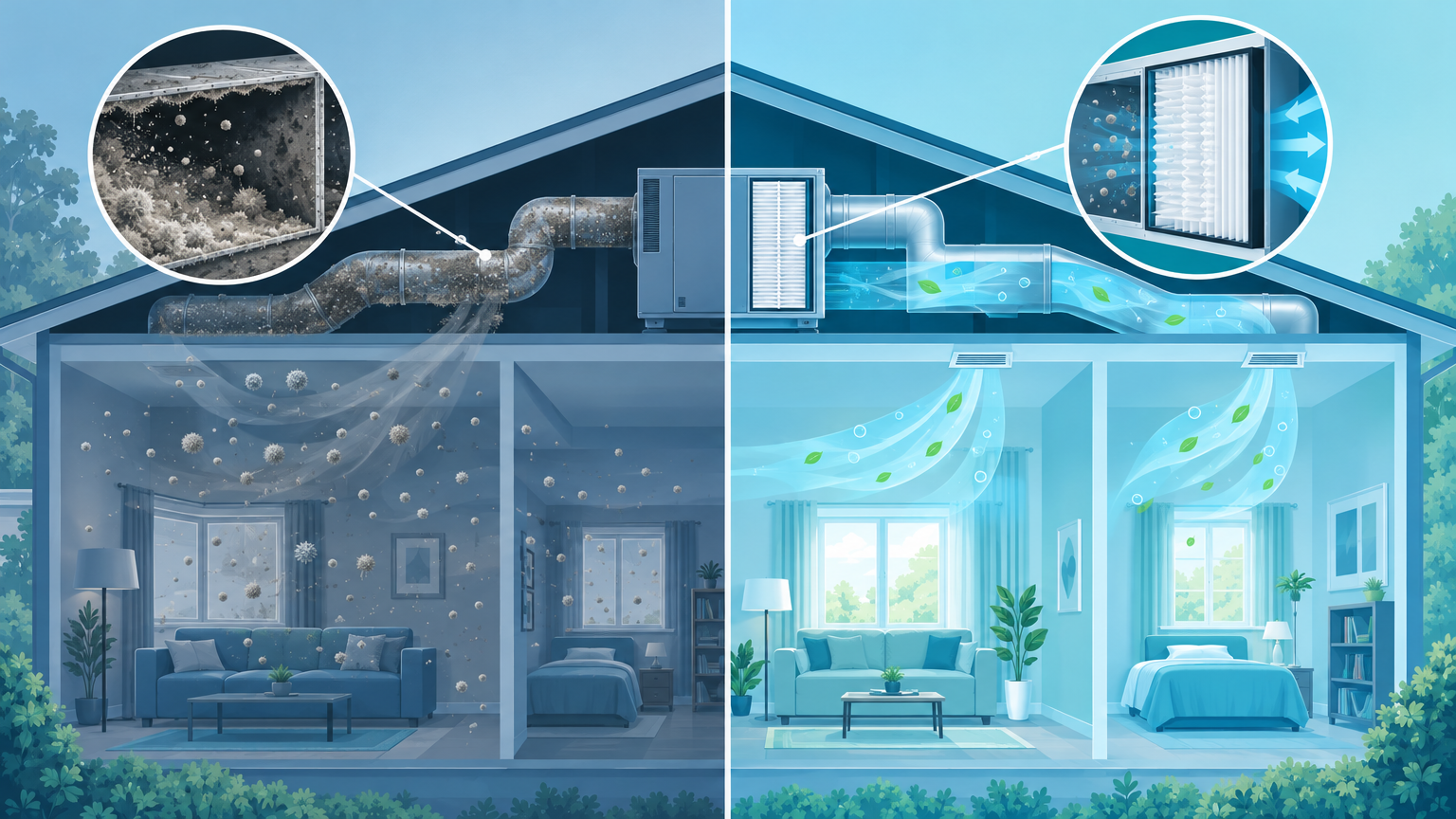
A legitimate professional cleaning takes 2 to 4 hours. Technicians use negative air pressure to contain disturbed particles, combined with industrial vacuum equipment and compressed air tools. They work through every supply duct, every return duct, all vents and grilles, and the air handler and blower compartment.
Containment is the critical technical requirement. If the vacuum system is undersized or improperly connected, the cleaning process itself can release more dust and contaminants than leaving ducts untouched. It can also physically damage ductwork or equipment. The EPA explicitly warns that improper duct cleaning can damage ductwork and system components, leaving the home worse off than before.
Why Technician Qualification Matters
The technical standard to look for is NADCA certification, specifically an Air System Cleaning Specialist (ASCS) on the crew. NADCA is the professional certification body for duct cleaning in the United States.
When vetting a company, ask whether they have NADCA-certified technicians on staff, not just whether they are NADCA members. Also ask whether the air handler and blower compartment are included in the quoted price.
A qualified technician will inspect your system before quoting a price, explain what work is needed and why, provide a written estimate, and use contained, professional-grade equipment throughout the job. That transparency protects against both damage and waste.
Duct Cleaning as Part of Long-Term HVAC Maintenance
Duct cleaning is not a substitute for regular HVAC maintenance, and maintenance is not a substitute for duct cleaning when cleaning is genuinely needed. They address different parts of the system.
The NADCA 3 to 5 year cleaning interval assumes that routine HVAC maintenance, including filter changes, coil cleaning, and seasonal tune-ups, is happening between cleanings. Without that foundation, ducts can return to a dirty baseline faster. A filter that is allowed to clog does not trap additional particles.
It becomes a restriction that forces debris past it and into the duct system.
Regular professional tune-ups catch early signs of moisture intrusion, mold risk, and airflow restriction before they develop into conditions that require expensive remediation. An HVAC technician who inspects the system at each visit is far more likely to catch a developing duct problem than a homeowner who never opens the air handler.
Cool Breeze HVAC Solutions: Maintenance and Duct Cleaning in Fairfax
Cool Breeze HVAC Solutions serves homeowners across Fairfax County and Northern Virginia. Their Fairfax Comfort Club maintenance plan is $19 per month and includes two tune-ups per year, priority service scheduling, and 15% off repairs and parts. Furnace diagnostics start at $89.
Services include indoor air quality assessment and duct cleaning alongside AC repair and installation, heat pump systems, furnace and heating, smart thermostats, and zoning. For homeowners uncertain whether their ducts need cleaning, a maintenance visit is a practical first step. A technician can inspect the system and give a direct, evidence-based answer before any cleaning work is scheduled.
Call Cool Breeze at (877) 368-4822 or book online to get started.
Three Steps to Take Now
Check your filters first. If you cannot remember the last time you changed them, change them now. During Fairfax's pollen seasons, that interval may need to be shorter than the manufacturer's default recommendation.
Check your system against the EPA's three triggers and the situational indicators listed above. If two or more conditions apply, schedule a professional inspection before the heating season begins.
Call Cool Breeze HVAC Solutions at (877) 368-4822 or book online to schedule an indoor air quality assessment or duct cleaning, or ask about the Fairfax Comfort Club at $19 per month for year-round maintenance coverage.
In perspective
Key facts
- Indoor air can be 2 to 5 times more polluted than outdoor air, according to the EPA. Source
- Fairfax County received a grade of D for air pollution in the American Lung Association's 2026 State of the Air report, ranking among the worst localities in Virginia. Source
- Tree pollen in Fairfax County begins as early as March and peaks in April and May; grass pollen rises through late spring and early summer; and ragweed follows through late summer and early fall. Source
- The EPA does not recommend routine duct cleaning on a schedule and identifies three specific conditions that warrant cleaning: substantial visible mold, pest infestation, or ducts clogged with heavy debris releasing particles into living spaces. Source
- Angi reports duct cleaning costs ranging from $150 to $800, with an average of $389 as of August 2026. Source
- The EPA and NADCA cite duct cleaning cost ranges of $450 to $1,000 depending on system size and scope. Source
- Improper duct cleaning can damage ductwork and system components, potentially leaving the home worse off than before. Source
- NADCA's professional certification standard includes the Air System Cleaning Specialist (ASCS) credential, which requires demonstrated technical knowledge of HVAC systems and cleaning methodology. Source
Frequently asked questions
Does duct cleaning actually make indoor air cleaner?
It depends on conditions. The EPA does not confirm a universal health benefit. However, when specific triggers are present (mold, pests, heavy debris, or post-renovation contamination), cleaning removes verified pollutant sources. The mechanical benefits to airflow and equipment are also documented.
How often should ducts be cleaned in Northern Virginia?
NADCA recommends every 3 to 5 years for most homes, with more frequent cleaning for homes with pets, smokers, allergy sufferers, or recent renovation work. Fairfax County's long pollen season and humid summers are additional factors that can accelerate buildup.
What are the EPA's specific triggers for duct cleaning?
The EPA identifies three: visible mold growth inside hard-surface ducts, confirmed pest or vermin infestation, and ducts so clogged with debris that particles are visibly being released into the home through registers. Outside these conditions, the EPA recommends focusing on prevention over routine cleaning.
How do I know if I have mold in my ducts?
A musty odor that appears specifically when the HVAC runs is the most common indicator. Visible dark discoloration around registers or inside duct openings is another. Mold inside duct insulation may not be visible without a qualified technician using a camera scope. If you suspect mold, have the system inspected before scheduling cleaning.
Is a $99 whole-house duct cleaning deal legitimate?
Almost certainly not. Industry data identifies those offers as a documented bait-and-switch pattern. A proper job takes 2 to 4 hours with professional equipment and costs between $150 and $800 on average. Pricing well below that floor warrants immediate skepticism.
How long does a professional duct cleaning take?
A standard residential cleaning takes 2 to 4 hours, covering supply ducts, return ducts, grilles, vents, and the air handler and blower compartment. A job completed in under an hour should be treated as a warning sign that the work was not done properly.
Can duct cleaning help with allergies in Fairfax?
It can be a contributing factor when HVAC operation is worsening allergy symptoms, particularly if the duct system has accumulated pollen, pet dander, or mold. Fairfax County's extended pollen seasons and humid summers create real conditions for duct contamination. However, filter maintenance and humidity control are the more consistently supported first steps.
What is NADCA certification and why does it matter?
NADCA (National Air Duct Cleaners Association) is the professional standards body for the duct cleaning industry. Their Air System Cleaning Specialist (ASCS) credential requires demonstrated technical knowledge. Choosing a company with NADCA-certified technicians is one of the most reliable ways to screen for quality before work begins.